You have booked your morning desert safari with Roar Adventure Tourism. Now comes the most common question every first-timer asks: what actually happens, and in what order?
This step-by-step guide walks you through every moment of a morning desert safari in Dubai from the early alarm call and hotel pick-up to dune bashing in a Certified Land Cruiser, sandboarding down the red faces of the Lahbab Desert, a camel ride at the Bedouin camp, and the drive back to the city. No surprises, no guesswork just a clear picture of exactly what your morning looks like.
This guide covers the complete morning desert safari experience for first-time visitors, families, and solo travellers booking with Roar Adventure Tourism from Dubai, Sharjah, and Abu Dhabi.
The Night Before: Your Preparation Checklist
A successful morning desert safari experience begins the evening before departure. Follow this checklist so nothing delays your pick-up or reduces your comfort on the dunes:
- Confirm your hotel pick-up time with Roar Adventure Tourism departure windows are typically 6:30–7:30 AM depending on your hotel location
- Lay out comfortable, lightweight, light-coloured clothing and closed-toe shoes sandals are impractical for sandboarding and dune climbing
- Charge your phone, camera, and any action cameras fully no power outlets exist in the desert
- Pack SPF 50+ sunscreen, UV-protection sunglasses, and a scarf or buff for dust during dune bashing
- Eat a light breakfast or snack heavy meals and off-road dune bashing are a poor combination
- Take motion sickness tablets 30 minutes before departure if you are prone to car sickness
- Keep a 1-litre water bottle to hand Roar supplies water at camp, but hydration before arrival matters
Roar tip: Set two alarms. Missing your pick-up window means missing the golden hour and that is the single best reason to book a morning safari in the first place.
Step-by-Step Morning Desert Safari Experience
Doorstep Hotel Pick-Up and Drive to the Desert 6:30 – 7:30 AM
Duration: 45–60 minutes Your certified Roar Adventure Tourism driver arrives at your hotel in a Toyota Land Cruiser 4WD at the confirmed pick-up time. Guests from Dubai Marina and Downtown typically depart around 6:30 AM; guests from Deira or Sharjah pick-up points may depart slightly later. The drive to the Lahbab Desert region takes approximately 45–60 minutes via the Dubai–Al Ain Road (E66). Your guide will brief you on the day’s itinerary, answer first-timer questions, and explain the safety rules for dune bashing during the journey. Roar tip: Use the drive time to ask your guide about wildlife tracking they know exactly where the Arabian oryx herds have been spotted recently.
What the journey looks like: The transition from Dubai’s skyline to open desert is gradual and striking. Within 30 minutes you will see the urban landscape give way to scrubland, then pale sand, and finally the deep terracotta-red dunes of Lahbab some reaching 100 metres in height. First-time visitors consistently describe this transition as one of the most visually dramatic moments of their Dubai trip.
Arrival at the Lahbab Dunes Safety Briefing 7:30 – 8:00 AM
Duration: 15 minutes On arrival at the designated staging area, all vehicles in the convoy gather for a formal safety briefing. This is a mandatory requirement for all DTCM-licensed operators including Roar Adventure Tourism. Your TÜV-certified guide covers: seatbelt usage (mandatory throughout), body position during sharp dune descents, what to do if you feel motion sickness, photography rules during movement, and the emergency stop signal. First-timers are encouraged to ask every question at this stage. Roar tip: The safety briefing is not a formality it is the reason our incident record is clean. Listen carefully, especially the guidance on keeping arms and legs inside the vehicle on dune crests.
Tyre Deflation and Convoy Formation 8:00 AM
Duration: 10 minutes Before entering the dune terrain, every Land Cruiser in the convoy undergoes tyre deflation tyre pressure is reduced from standard road pressure (around 35 PSI) to approximately 15–18 PSI. This is one of the most important technical steps in safe dune bashing: lower pressure increases the tyre’s contact patch, dramatically improving traction, stability, and rollover resistance on soft sand. You will hear the air release and see the tyre profile visibly widen. Vehicles then form a convoy line with spacing maintained for safety. Roar tip: Many tourists do not realise that tyre deflation is what separates a smooth, controlled dune experience from a dangerous one. It is a non-negotiable step that no reputable operator skips.
Dune Bashing The Main Event 8:10 – 9:00 AM
Duration: 45–60 minutes Dune bashing is the centrepiece of any morning desert safari experience. Your driver navigates the Land Cruiser at speed up steep dune faces, crests, and descents sometimes dropping sharply down a near-vertical face at angles that feel genuinely extreme. The sensation is a cross between a roller coaster and off-road racing. The Lahbab Desert’s red dune formations provide both dramatic scenery and technically challenging terrain that showcases the driver’s skill. Convoy driving ensures vehicles are never isolated, and guides maintain radio contact throughout. Roar tip: First-timers: the sharp descent moments feel scarier than they are. Trust the tyre pressure, trust the driver’s TÜV certification, and keep your seatbelt on. The shouts of excitement in the vehicle are always louder than any nerves after the first dune.
What dune bashing feels like
| Moment | What happens | Sensation |
| Climbing a dune face | Vehicle accelerates sharply up 40–60° slope | Pressing back into seat, engine roar |
| Cresting the top | Brief pause at the peak, full desert view visible | Sudden quiet, panoramic vista |
| Steep descent | Nose drops, driver controls speed down face | Stomach-drop, controlled slide |
| Flat valley crossing | High-speed traverse between dune bases | Rally-car sensation, lateral movement |
| Sidewall traversal | Vehicle angled sideways along a dune face | Tilted, gripping the handle thrilling |
Free Time on the Dunes Sunrise Photography 9:00 – 9:20 AM
Duration: 20 minutes After the main dune bashing session, the convoy stops at a scenic high-dune vantage point for a free exploration and photography break. This is the golden hour photography window the period when the low-angle sunrise light carves long shadows across every ripple in the red sand and the sky transitions from pink to deep blue. Your guide will identify the best vantage points. You can walk up the nearest dune face, explore the surrounding terrain on foot, or simply sit in the silence of the Arabian desert before the heat builds. Roar tip: Climb to the crest of the nearest dune and look back toward Dubai on clear January and February mornings, the city skyline is faintly visible on the horizon. It is one of the most unexpected and beautiful shots of any Dubai trip.
The Arabian desert at sunrise is classified as a crepuscular wildlife zone most active between 30 minutes before and 60 minutes after sunrise. This is your highest-probability window for Arabian oryx, sand gazelle, and desert raptor sightings.
Sandboarding 9:20 – 9:45 AM
Duration: 20–25 minutes After the photography break, the group moves to a designated sandboarding dune typically a long, consistent face with a clear run-out at the base. Your guide distributes boards, adjusts foot straps, and provides a brief standing-up technique demonstration. No prior snowboarding or skateboarding experience is required. Most guests start on their stomach (bodyboard style) and progress to standing with guidance. The red sand provides a fast, smooth surface that beginners find surprisingly forgiving. Roar tip: Wax the bottom of your board with the supplied wax block it makes a significant speed difference. And tuck your trousers into your socks or use the provided ankle gaiters to keep red sand out of your shoes.
Short Camel Riding 9:45 – 10:10 AM
Duration: 15–20 minutes The convoy proceeds to the desert camp, where a guided camel trek awaits. Camels are loaded and unloaded with a distinctive rocking motion you will feel the animal lean back sharply as it stands from its knees, then forward as it rises to full height. The short trek covers a section of flat desert terrain at a walking pace, giving you a unique elevated vantage point for photography and a tactile connection to the Bedouin transport tradition that shaped the Arabian peninsula for centuries. All camels used by Roar Adventure Tourism are domesticated and handler-accompanied. Roar tip: Hold the saddle pommel firmly on the stand-up and sit-down transitions those are the moments first-timers lose their balance. Once the camel is walking, the rhythm is surprisingly smooth.
Bedouin Camp Qahwa, Dates & Cultural Experience 10:10 – 10:50 AM
Duration: 35–40 minutes The Bedouin camp is where the morning safari transitions from adrenaline to atmosphere. Roar Adventure Tourism’s traditional Arabian camp features low-seating majlis areas, decorative lanterns, woven fabrics, and a central refreshment station. You will be welcomed with qahwa Arabic cardamom coffee served in small handleless cups (finjan) alongside a selection of dates, dried fruits, and light refreshments. Traditional kandura (men’s white robe) and abaya (women’s full-length robe) are available for complimentary photo opportunities. A resident henna artist is available for optional hand art. Roar tip: Hold your finjan cup between two fingers to signal to the host that you would like more coffee, or give a small shake to decline. This is a genuine piece of Emirati hospitality etiquette your fellow travellers will be impressed.

The camp experience offers the cultural anchor the morning safari needs a moment of quiet reflection, genuine Arabian hospitality, and the kind of unhurried atmosphere that large evening group tours rarely achieve.
Add-On Activities: Quad Biking & Dune Buggy 10:10 – 10:50 AM
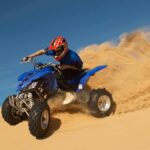
Concurrent with camp time For guests who booked the Morning Safari with Quad Bike (AED 279/person) or Morning Safari + Dune Buggy (AED 365/person), add-on activities run concurrently with the camp refreshment period. Quad biking gives you 30 minutes of independent dune riding on a 250cc quad with an instructor escort. The dune buggy (2-seater, roll-cage protected) delivers 30 minutes of high-speed dune traversal the most intense single activity available on any Roar morning safari. Both activities require helmets and full safety briefings before departure. Roar tip: If you are travelling with a mixed group where some want maximum adventure and others prefer the camp atmosphere, add-ons work perfectly the adventurers ride while the rest enjoy qahwa in the majlis.
Return Journey and Hotel Drop-Off 11:00 – 11:45 AM
Back at hotel by 12:00–1:00 PM After the camp experience, your driver re-inflates the tyres (returning them to road pressure for the highway journey) and begins the return drive to Dubai. The convoy retraces its route via the Dubai–Al Ain Road, arriving at your hotel or a central drop-off point by midday or 1:00 PM. Your Roar guide will confirm your drop-off time before departure from the camp and will request a review of your experience genuine feedback that shapes every future tour. Roar tip: Use the return journey to review your photos with your guide they can identify wildlife you captured without realising (oryx tracks, dung beetles, desert larks) and share context that deepens your understanding of what you actually saw.
Full Morning Desert Safari Timeline At a Glance
Use this summary table as your complete reference for the morning desert safari hour-by-hour schedule:
| Time | Activity | Duration |
| 7 – 7:30 AM | Hotel pick-up and drive to Lahbab Desert | 45–60 min |
| 7:30 – 8:00 AM | Arrival, safety briefing at dune staging area | 15 min |
| 8:00 AM | Tyre deflation and convoy formation | 10 min |
| 8:10 – 9:00 AM | Dune bashing (main off-road experience) | 45–60 min |
| 9:00 – 9:20 AM | Free time on dunes, sunrise photography | 20 min |
| 9:20 – 9:45 AM | Sandboarding on designated dune face | 20–25 min |
| 9:45 – 10:10 AM | Camel riding at the desert camp | 15–20 min |
| 10:10 – 10:50 AM | No Camp acitivites, Arabic Attire Photos | 35–40 min |
| 10:10 – 10:50 AM | Add-ons: quad biking or dune buggy (if booked) | 30 min |
| 11:00 AM | Tyre re-inflation and departure from desert | 10 min |
| 11:30 AM – 1:00 PM | Return drive and hotel drop-off | 45–60 min |
What’s Included vs Not Included
| Included in standard morning safari | Not included (available separately) |
| Hotel pick-up and drop-off (Dubai, Sharjah) | BBQ dinner or full meal service |
| Certified off-road driver and DTCM-licensed guide | Cultural entertainment (belly dance, tanoura, fire show) |
| Dune bashing in Toyota Land Cruiser 4WD | Quad biking (AED 279/person add-on) |
| Sandboarding with board and foot straps provided | Dune buggy ride (AED 365/person add-on) |
| Camel riding at the desert camp | Professional photography service |
| No Camp Activities | Alcoholic beverages |
| Traditional attire (kandura/abaya) photo opportunity | Falconry demonstration (exclusive package only) |
| Mineral water throughout | Henna art (optional extra at camp) |
Does the morning desert safari experience change by season?
Yes significantly. October to April is the optimal window. December to February delivers the best combination of cool temperatures (15–22°C), dramatic red dune light, and the highest Arabian oryx sighting frequency of any month. May to September sees temperatures exceeding 40°C by 9:00 AM dune bashing is technically possible but physically taxing, and we do not recommend it.
What is the best seat in the Land Cruiser for dune bashing?
The middle row, window seats. You get the visual drama of the dune faces without the roughest movement (which falls to the rear row). The front passenger seat offers the most dramatic view but the least lateral support. First-timers with motion sickness concerns should request the middle row on booking.
Is there a toilet at the desert camp?
Yes. Roar Adventure Tourism’s Bedouin camp has clean, maintained portable toilet facilities. Given the 4 hour duration and morning timing, most guests use the facilities once during the camp stop. It is advisable to use your hotel bathroom before departure regardless.
Do you see the sunrise on a morning desert safari?
Typically yes, during the Step 5 free photography break around 9:00–9:20 AM especially in winter months when sunrise occurs between 6:50 and 7:10 AM. You arrive at the dunes just as the light turns golden. In summer, sunrise is earlier (around 5:40 AM) and the photography break occurs in brighter, harsher mid-morning light rather than the golden hour.
Is morning desert safari better than evening for photography?
Morning wins for: golden-hour directional light, shadow texture on dunes, cooler conditions for extended outdoor shooting, and less crowded vantage points. Evening wins for: sunset colour gradients, star photography after dark, and campfire lighting for portrait shots. Both are exceptional the difference is the type of light, not the quality.
What happens if you feel sick during dune bashing?
Signal to your driver immediately using the pre-briefed emergency stop signal (a raised hand from the middle row is standard). All Roar drivers are trained to pull over safely and quickly. Motion sickness bags are available in every vehicle. The convoy will wait for any guest who needs a short recovery pause. You are never pressured to continue if you feel unwell.
How long does a morning desert safari last from start to finish? From hotel pick-up to drop-off, a Roar Adventure Tourism morning desert safari runs approximately 4-5 hours. The time in the desert itself (dune bashing through camp visit) is 3 to 3.5 hours. Drive time each way adds 45–60 minutes depending on your hotel location.
Can beginners do sandboarding on a morning desert safari? Absolutely. Sandboarding at the beginner level requires no prior experience. Most guests start on their stomach in a bodyboard position, then progress to kneeling and eventually standing with the guide’s assistance. The red sand is forgiving and fast the majority of first-timers are confidently standing within two or three runs.
What is the experience like in a private car versus a shared group? A shared group tour (up to 12 guests across multiple vehicles) offers a sociable, energetic atmosphere strangers become companions quickly in the shared experience of dune bashing. A private car (AED 599 for up to 6 passengers) gives you full control of pace, route adjustments, and guide attention. Families with young children and photography enthusiasts consistently choose private for the flexibility it allows.
How early do you need to wake up for a morning desert safari? Plan for a 6:00–6:15 AM wake-up for a 6:30–7:00 AM pick-up. Allow time to dress, apply sunscreen, eat a light snack, and meet your driver in the hotel lobby. Rushing the morning increases the chance of forgetting essentials charged devices, sunscreen, and closed-toe shoes are the three most commonly forgotten items.
Morning Desert Safari Experience
- The morning safari runs 4-5 hours total from hotel pick-up to drop-off
- 10 distinct steps from pick-up to return, each with a different activity and atmosphere
- Dune bashing is the longest and most intense activity (45–60 minutes)
- No Camp Activities
- Golden-hour photography window occurs around 9:00–9:20 AM (winter months)
- Wildlife sightings (Arabian oryx, gazelle) are most probable at the Step 5 photography break
- Add-ons (quad bike AED 279, dune buggy AED 365) run concurrently with camp time
- All vehicles are TÜV-certified; all guides are DTCM-licensed
- Private car (AED 599 for up to 6) recommended for families and photography enthusiasts
Ready to experience every one of these steps in person? Book your morning desert safari with Roar Adventure Tourism from AED 149/person or upgrade to the private car option at AED 599 for a group of up to 6. Use code ROAR-MORNING for 10% off your first booking. Roar Adventure Tourism | Dubai Desert Safaris | DTCM Licensed All rights reserved.